Why Growth Mindset Matters for Your Child’s Musical Journey
In This Article
You will learn what a growth mindset is, why it matters so much in music lessons, how AGMS teachers build it into every class, and four simple ways you can nurture a growth mindset at home so your child becomes more confident and resilient at the piano, guitar, ukulele, or voice.
Reading time: ~6 minutes
Introduction
You have probably heard it before: “She’s just naturally musical” or “He’s not really a music kid.” But here is what research and experienced music teachers know: the most important factor in your child’s musical journey is not “natural talent.” It is how your child thinks about learning. A growth mindset (the belief that abilities can be developed through effort, effective strategies, and support) changes everything about how your child experiences practice, performance, and the moments when things don’t go as planned.
At a studio rooted in a growth mindset like Avant-Garde Music Studio (AGMS), we don’t call these moments “mistakes.” We call them learning moments. Why? Because the language we use shapes how your child thinks about challenges. When your child hears “That was a learning moment” instead of “You made a mistake,” they begin to see difficulty as information to act on, not proof that they lack talent. They learn that stumbling is part of the process, not a sign of failure. At AGMS, music lessons become more than scales and songs. They become a laboratory for confidence, resilience, and lifelong learning. And when your child starts to believe that they can grow through these learning moments, it changes how they approach challenges, not just in music, but everywhere.
What is a growth mindset, and why does it matter for your child’s music?
Psychologist Carol Dweck describes a growth mindset as the belief that intelligence and ability can grow with effort, good strategies, and help from others, as opposed to a fixed mindset, which sees ability as something you either “have” or “don’t have.” When your child has a growth mindset, they’re more likely to embrace challenges, persist when things feel hard, and see learning moments as information instead of proof that they “aren’t good enough.”
Large studies show that when children learn to think this way, they earn higher grades, persist longer at difficult tasks, and are more willing to tackle challenging work. This is true even more so than peers with equal starting ability but a fixed mindset. In other words, believing you can grow helps most when learning feels difficult, or when you are tempted to let your child give up.
Music is where this belief becomes visible and audible. Unlike many things children learn, musical progress is almost immediately connected to the quality of practice and your child’s willingness to work through frustration. Research on music education shows that when your child sees musical skill as something developable (rather than as a fixed talent that either “clicks” or doesn’t) they use better practice strategies, stay in lessons longer, and get to the same performance level with less of that frustrating, exhausting “grinding.”
In the elementary and early childhood music context specifically, when studios use growth-mindset approaches (praising effort, allowing playful experimentation, and normalizing learning moments), children show greater confidence, more risk-taking, and longer-term engagement with music. Your child is more likely to keep music in their life, not just for this year, but for years to come.
How a growth mindset changes your child’s music lesson
A growth mindset doesn’t live in posters on the wall. It lives in the small, repeated moments of each lesson: the words your child’s teacher uses when they encounter a tricky spot, the way a passage is broken down, and how progress is framed over weeks and months.
Three key shifts happen when music lessons are grounded in a growth mindset.
Your child learns that learning moments are “clues,” not verdicts
In a fixed mindset, a wrong note confirms your child’s worst fear: “I’m not musical.” That fear can lead to avoidance (choosing easier pieces, dreading performances, or quitting altogether).
In a growth mindset, learning moments are treated as information: “That F-sharp keeps sneaking in. What could we try differently?” Music is actually an ideal context for this shift, because your child can hear how deliberate practice transforms sticky spots into satisfying musical results, building a direct link between effort and improvement.
At AGMS, studio language is intentionally designed around this principle. When your child has a learning moment, teachers are guided to replace critical language with phrases that shed light on the music in a positive, non-shaming way. “It looks like there was a little ‘oopsie’ here; let’s listen and see what the composer wrote,” or “That was a very creative version. Now let’s honour what’s on the page.” This kind of language keeps the door open for your child’s curiosity instead of closing it with judgment.
One of our students, preparing for her Level 8 RCM exam, shared how she used to be nervous about the pressure. But her teacher didn’t focus on perfection; she focused on connection. Instead of stressful drilling, lessons were flexible and fun, turning high-level exam prep into a series of engaging challenges. She told us her teacher “worked with me to achieve my own goals… ensuring that I always had lots of fun.” The result? She walked into that major exam feeling prepared, not panicked, knowing her teacher was on her team.
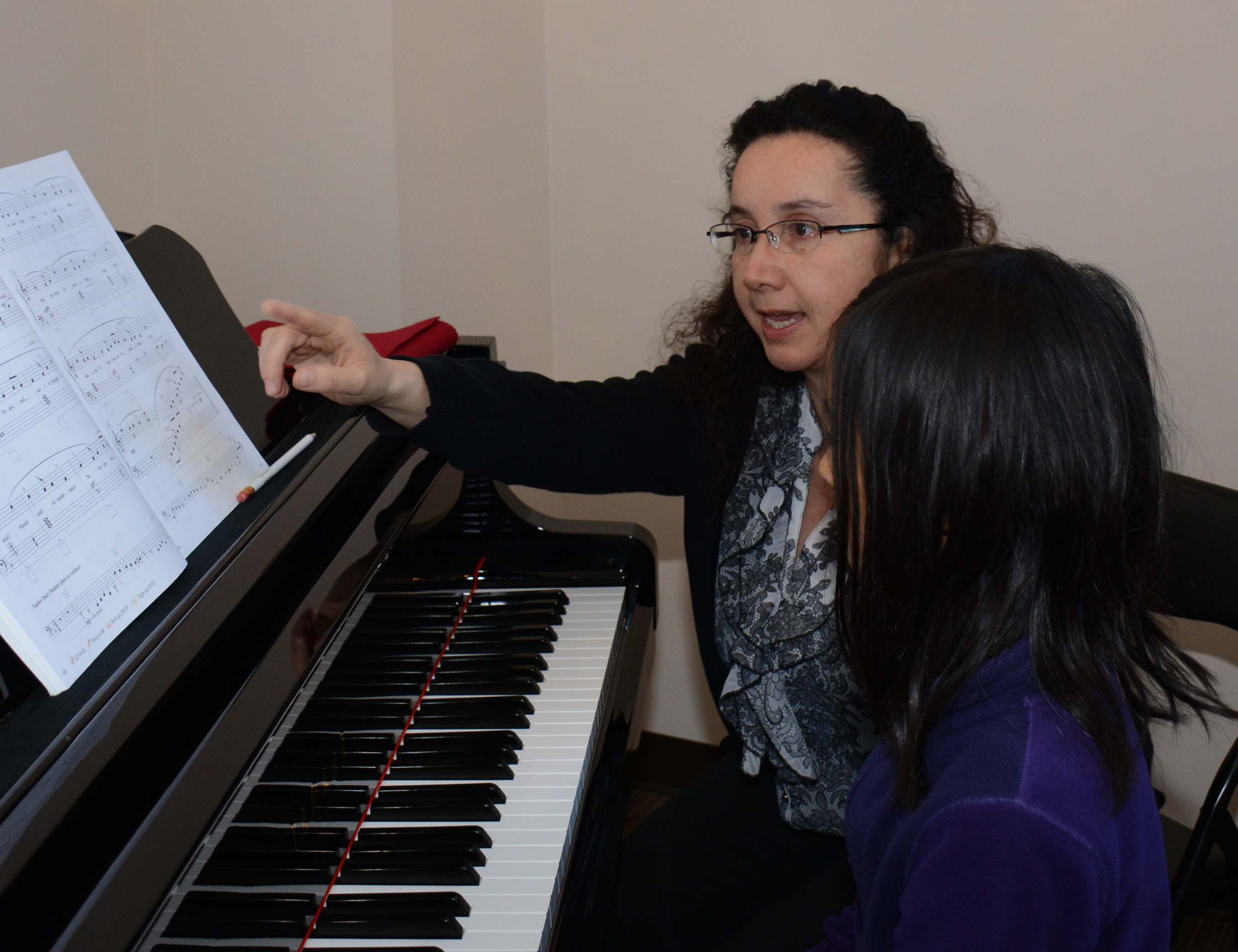
Your child sees that effort, strategy, and progress are what matter
Research on motivation in music education shows that students thrive when they feel competent, connected, and autonomous. They thrive when they can see their skills growing, feel supported, and have some choice in how they learn. Growth mindset teaching pulls these pieces together by spotlighting how your child got better: the slow practice, the counting out loud, the willingness to try a tricky bar in different ways.
Across education broadly, when children understand that grades and progress come from effort and strategy (not fixed talent), they earn higher grades and are more willing to tackle challenging work. This is true for all students, regardless of their past grades or family background. In large-scale trials, brief growth-mindset interventions raised GPAs and increased enrolment in advanced courses for students who had previously struggled.
In the music room, this looks like:
- Your child’s teacher highlights specific, effort-based wins (“You practised hands separately all week, and now that left hand is so much steadier.”)
- Tracking small steps over time so you and your child can see the growth (“Last month you could play this section at 60 bpm; today it’s at 80, and it still sounds musical.”)
- Connecting strategies to outcomes (“When you slowed it down and circled the dynamic marks, your phrasing came alive.”)
The AGMS’s mission explicitly prioritizes this kind of growth. Your child is invited to “give their absolute best,” build a “solid music foundation,” and develop resourcefulness. They learn to see unmet goals as “sources of information to recalibrate,” not reasons to quit.
My teenage daughter has started to enjoy learning and playing piano once again due to her very influential music teacher. She went from feeling stuck to loving the lessons.”
— Parent of a Teen Student, Verified Google Review
Your child is more likely to stay with music
One of the biggest challenges in music education is dropout. Studies in school and studio settings suggest that children are more likely to persist in music when their basic psychological needs are supported. They need to feel capable, feel connected to others, and have some control over their learning. Growth mindset practices reinforce all three: your child feels more capable because they see themselves improving; they feel more connected because their teacher responds to learning moments with support, not judgment; and they feel more in control because they understand that their actions influence outcomes.
Research reviews consistently show that when children internalize a growth mindset, they disengage less, persist longer, and stay committed to what they’re learning. In music, where progress is visible and audible, these mindset shifts are especially tangible. Your child who once dreaded practice begins to approach it as a puzzle they know how to solve, not a test they’re destined to fail.
AGMS’s blended Solo and Ensemble model (individual time plus collaborative learning) creates many chances for your child to experience this. They try something risky in a supportive group, hear peers improve over time, and feel that their own contribution matters to the sound of the whole ensemble.
When 6-year-old Kyra first joined our FunTime Piano program, she was so shy she cried during the first few lessons and needed her grandma to stay in the room. In a fixed mindset, we might have decided she “just wasn’t ready.” Instead, her teacher focused on growth, honouring Kyra’s pace and celebrating her small efforts. This support taught Kyra that confidence is something you build, not something you have to be born with. By the time she finished the program, the tears were long gone, she had become a confident, fast learner who loved participating in class.
What a growth mindset looks like at AGMS
When you choose AGMS, you’re choosing a studio where a growth mindset isn’t a buzzword. It’s how every lesson, recital, and studio-wide event is designed. The studio’s mission is to help your child “develop your inner musician with a growth mindset”(Learn more about the ARIA Program to see how solo and ensemble instruction work together). This means:
- Intentional language: Your child’s teachers are trained to use student-centred, positive wording, to acknowledge effort, and to frame challenges as opportunities. Simple phrases like “Not yet” instead of “You can’t” help your child see skills as “in progress” rather than fixed.
- Honouring your child’s pace and learning style: The student journey at AGMS is described as moving from guided support to more independent, self-directed learning, always at your child’s own pace. This reinforces the idea that growth is personal, not a race.
- Safe performance opportunities: Recitals, informal sharings, and ensemble work are positioned as experiences to grow confidence and expressiveness, not pass–fail tests. Research shows that low-stakes performances and supportive feedback loops are powerful for building resilience in young musicians.
A mom of one of our voice students recently shared a powerful observation after our last recital. She told us, “I’ve noticed that at every recital, my daughter’s voice projection gets better and better.” This wasn’t an accident, it was the result of a deliberate, year-over-year focus by her teacher. It’s a perfect example of what we mean by growth mindset: we don’t just look for a ‘perfect’ performance today; we look for the steady, exciting progress that happens when a student keeps showing up and doing the work.
— Mother of an AGMS Voice Student
How you can nurture a growth mindset in music at home
You play a crucial role in whether your child internalizes a growth or fixed mindset about music. Your words, reactions, and the routines you create matter deeply (Explore our Piano Lessons for Kids to see how structured, supportive instruction fits into your family’s schedule) . Here are a few evidence-based shifts you can make starting today.
1. Praise effort, strategy, and courage, not “talent”
Swap “You’re so talented!” for “You worked really hard on that new chord” or “I noticed how bravely you kept going after that learning moment.” When you praise effort instead of innate ability, your child learns that doing the work is what creates skill, not being born “naturally good.”
2. Normalize learning moments as growth opportunities
When practice gets messy, try: “This part is tricky. That means your brain is growing” or “What did you learn from that run-through?” Dweck’s research and music-education studies emphasize that treating learning moments as opportunities is central to whether your child truly believes they can improve.
3. Focus on routines and small wins
Short, regular practice (with clear, achievable goals) builds both skills and self-belief more effectively than last-minute cramming. A simple chart celebrating “I practised three times this week” or “I worked on that sticky spot for 10 minutes today” reinforces the connection between persistence and progress. Your child sees that showing up matters.
4. Use “yet” language
When your child says, “I can’t play this,” gently add, “yet.” Then brainstorm one small step they can try today. “You can’t play it yet. But let’s try it hands separately, and we’ll see what happens.” This tiny word has been shown to support your child’s willingness to take on challenges and reduce the fear of failure.
Conclusion and invitation
When your child learns that musical ability is something they build (not something they either “have” or “don’t have”), everything changes. Practice becomes less about proving worth and more about exploring what is possible. Learning moments become “clues” that guide the next step. Performances become celebrations of growth, not verdicts on talent.
Your child deserves to experience what it feels like to work toward something hard, encounter a sticky spot, adjust, and finally nail it. That experience (repeated over and over in a supportive environment) teaches resilience, self-belief, and courage that reaches far beyond the music room.
Avant-Garde Music Studio’s mission is to inspire your child to give their absolute best, develop a solid musical foundation, and grow as a confident, expressive performer with a growth mindset. Every Solo and Ensemble class, every carefully chosen word of feedback, and every recital experience is designed to help your child believe in their own capacity to grow.
If this is the kind of learning environment you want for your child, join us at our monthly open house to see a growth mindset in action. See our Studio Tour to explore how we create a growth-minded space. Meet our teachers, explore our studio, and watch how your child responds to a space where learning moments are treated as information and effort is celebrated. One visit can be the beginning of a new way for your child to think about music, learning, and what they are capable of (on the piano bench and far beyond it).
Explore the research behind our approach
Columbia University Academic Commons. (n.d.). Growth Mindset in the Elementary Music Classroom. Retrieved from https://academiccommons.columbia.edu/doi/10.7916/3gz2-qa07academiccommons.columbia
Musical Child Australia. (2025, April 15). The ‘Carol Dweck Growth Mindset’ Effect on Early Music Learners. Retrieved from https://www.musicalchild.com.au/carol-dweck-growth-mindset/musicalchild
Yeager, D. S., Hanselman, P., Walton, G. M., et al. (2019). A national experiment reveals where a growth mindset improves achievement. Nature, 573, 364–369. https://doi.org/10.1038/s41586-019-1466-ynature
Dweck, C. S. (2006). Mindset: The new psychology of success. Random House.pmc.ncbi.nlm.nih
Evans, P., McPherson, G. E., & Schubert, E. (2015). An approach to motivation in music education. In G. E. McPherson (Ed.), The child as musician: A handbook of musical development (pp. 184–203). Oxford University Press.selfdeterminationtheory
Grit, Growth Mindset, & Greatness. (n.d.). Harnessing the power of failure in your music classroom. University of New Mexico Educational Leadership & Organizational Development.scholarworks.utrgv