How to Support Your Child’s Music Practice at Home (Even If You Are Not a Musician)
Do not have a music background? No problem. Learn practical, judgment-free strategies to support your child’s home music practice. You do not need to read music or play an instrument to be an incredible practice partner. Discover simple ways to create a supportive environment and help your child thrive musically.
Reading time: 6 minutes
Many parents without a music background worry they cannot help their child succeed in music lessons. The truth is simple: you do not need to be a musician to be your child’s greatest asset in their musical journey. While your child’s teacher at Avant-Garde Music Studio provides expert instruction once a week, the consistent practice that happens at home between lessons is where real progress unfolds. And you can absolutely support that practice, even if you have never played an instrument in your life.
Research is clear on this point. Children whose parents actively support practice, regardless of the parent’s own musical training, are significantly more likely to continue with music long-term and develop stronger musical skills. In fact, music teachers often say the most important thing a non-musical parent can do is simply be present, show interest, and create an encouraging environment. This guide will show you exactly how to do that.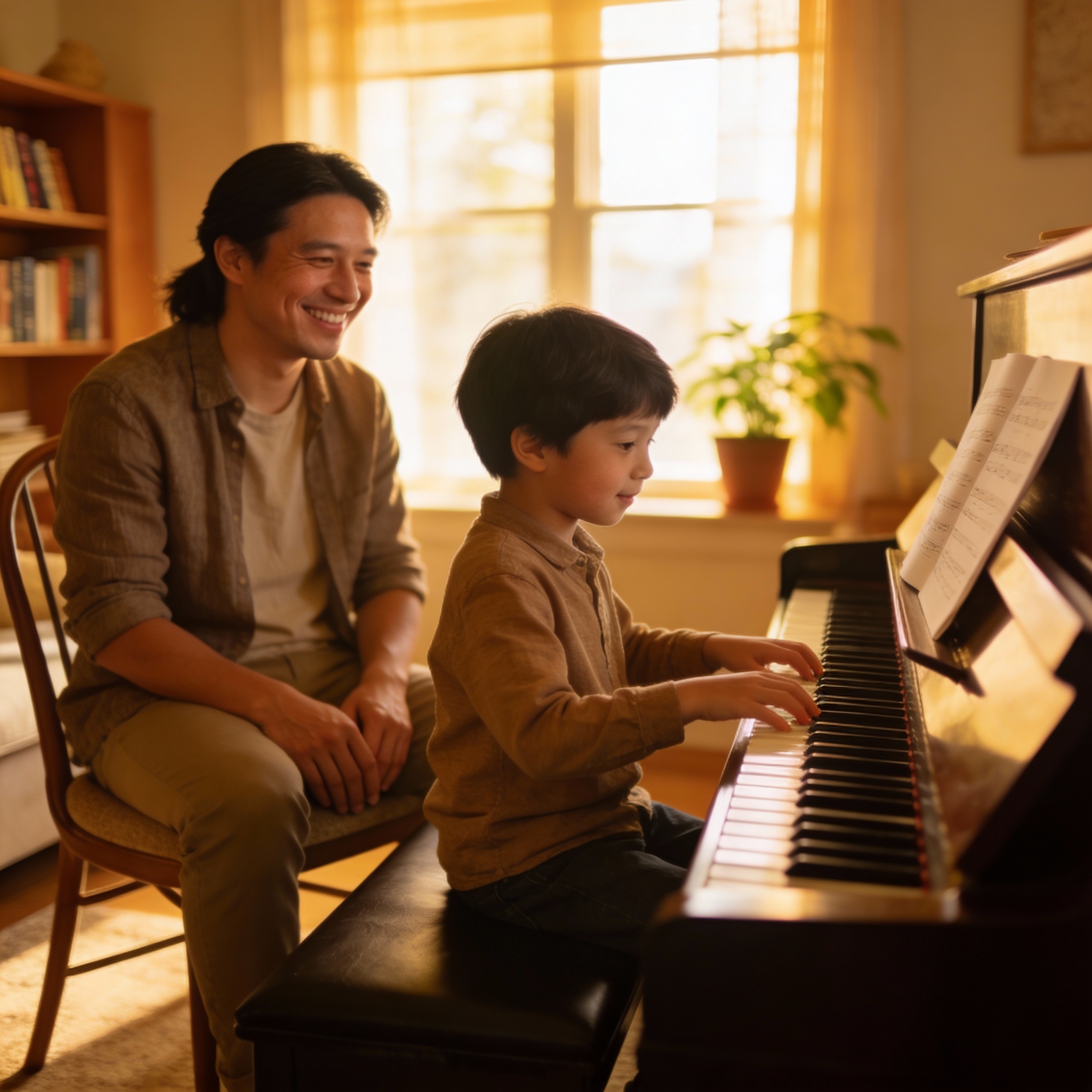
You do not need to know music to be a practice partner
This is the biggest misconception parents without musical backgrounds hold. You might think, “I cannot help because I cannot read music” or “I do not know if they are doing it correctly.” Here is the liberating truth: your role as a parent is not to be a substitute teacher. Your role is to be a supportive presence and a practice coach.
Think of it like learning to ride a bike. You would not expect your child to learn bike riding alone. You would stand beside them, offer encouragement, help them when they get stuck, and celebrate when they succeed. Music practice works the same way. Your child needs you there, not because you need to correct their technique, but because your presence and encouragement make an enormous difference.
Here is what the research shows: children with non-musical parents who sit nearby during practice, offer encouragement, and help their child follow the teacher’s written instructions show the same level of progress as children with musically trained parents. The presence matters. The support matters. Musical knowledge is optional.
Simple strategies that work without musical background
You do not need fancy techniques or musical expertise. Here are straightforward approaches that any parent can use, regardless of background:
Ask your child to show you what they learned. Before practice starts, ask your child to explain what they are working on. Have them show you the pieces or exercises in their book. Ask simple questions like “What is the teacher asking you to do this week?” or “Can you show me the part that is tricky?” This accomplishes several things at once. First, it helps your child clarify the goals in their mind. Second, it requires them to read the teacher’s notes (which they often skip). Third, it gives them an audience, which boosts motivation.
You do not need to understand music theory or technique to do this. The teacher has written instructions for exactly this purpose.
Let your child be the teacher. Children love teaching. Ask your child to teach you what they are learning. Ask them to explain how to hold the instrument, what the notes are, or what the song is about. One of the best ways to learn something deeply is to teach it to someone else. Plus, when your child explains to you, they are reinforcing their own understanding.
Sit with them during practice. This one is so simple yet so powerful. Research shows that when parents sit nearby during practice time, without hovering or criticizing, children practice longer and with better focus. You do not need to correct them or guide their fingers. Simply being present communicates that their practice matters. You might read a book, do quiet work, or just listen. The key is being there.
Read the teacher’s notes together. Before each practice session, read the teacher’s written instructions together. You do not need to understand music to read English. The teacher writes things like “Play page 5 three times” or “Work on the rhythm in measure 8.” Read these notes aloud to your child, or have your child read them to you. Make sure they understand what the teacher is asking. This simple step eliminates a huge amount of wasted practice time.
Ask them to play for you. After they practice, ask your child to play a mini-concert for you. Tell them you want to hear how they have improved. This gives them an audience and motivation to practice well. You do not need to critique. Just listen, clap, and say things like “I heard how hard you worked on that part” or “That sounded beautiful to me.” You are not evaluating whether they are playing correctly. You are celebrating their effort.
Creating the right environment without any musical knowledge
The physical and emotional space you create matters enormously, and you do not need musical training to set this up.
Designate a quiet practice space. Your child needs a place without distractions where they can focus. This does not need to be fancy. A quiet corner of the living room with a chair and good lighting works perfectly. Keep television, younger siblings, and other interruptions away during practice time. One simple step: close the practice space door or put a “practice in progress” sign up so family members know to be quiet.
Establish a consistent practice time. Children are creatures of habit. When practice happens at the same time every day, it becomes part of the routine, like brushing teeth or eating breakfast. Research shows that consistency matters far more than duration. Practicing 4 to 5 times per week for 10 to 15 minutes is far more effective than sporadic longer sessions. Pick a time that works for your family, tell your child that is when practice happens, and stick to it. The battles decrease dramatically when practice is not negotiable.
Use encouragement, not pressure. This is where your non-musical perspective is actually an advantage. Without worrying about whether your child is playing the right notes, you can focus on the most important thing: encouraging their effort. Use language that shows you value their practice, like “I love that you are working on this” and “I can hear how much you are concentrating” and “You are sticking with that tricky part. I am proud of you”.
Avoid saying things like “You got that wrong” or “Why are you not better at this yet?” Even if you hear mistakes, your job is not to correct them. Your job is to encourage. The teacher will address technique. You address effort and attitude.
One parent shares her simple formula for success: “I have always encouraged my kids to have fun with music, which makes practicing less stressful. Simply showing interest in what they’re playing… has helped to create an environment that supports their learning.” Tricia H.
Celebrate small wins. When your child masters something, no matter how small, acknowledge it. Maybe they play a new piece all the way through for the first time. Maybe they stop getting frustrated when they make a mistake. Maybe they practice without complaining for the whole week. These wins matter.
When practice feels hard, approach with empathy
Children without musical background sometimes feel frustrated or want to quit. Parents without musical background sometimes worry they are doing it wrong. Here is how to navigate this together.
If your child resists practice, stay calm and curious. Ask questions instead of insisting: “What is hard about this?” “Do you feel overwhelmed?” “Is the piece too challenging?” “Do you need a break?” Approach it as a puzzle to solve together, not a behavior problem to fix.
If you feel uncertain about whether you are helping correctly, reach out to the teacher. One of the greatest strengths of working with quality music instruction, like at AGMS, is that teachers expect questions from non-musical parents. They are happy to explain what they are working on and how you can support. Send a quick email or catch the teacher after a lesson and say, “I want to support practice at home. What should I focus on?” Teachers love this.
You absolutely can do this
Supporting your child’s music practice at home requires no musical background. It requires only your time, your presence, and your consistent encouragement. Research confirms that parental support, regardless of the parent’s own musical training, is one of the strongest predictors of children’s success in music.
You do not need to read music. You do not need to play an instrument. You do not need to understand music theory. You simply need to:
- Show up consistently during practice time
- Ask your child to explain what they are learning
- Listen without judgment
- Celebrate effort and progress
- Create a quiet, distraction-free space
- Maintain a consistent schedule
At Avant-Garde Music Studio, our ARIA program is specifically designed to work beautifully with families like yours. Our teachers know how to guide students AND how to support parents. You will never feel lost or unsupported. We have worked with dozens of families without musical backgrounds, and their children thrive.
Ready to give your child the gift of music education without worrying about your own musical knowledge? Book your free trial class during AGMS Open House Week. Our teachers will answer all your questions, explain how you can support practice at home, and help you feel confident every step of the way. Visit avant-gardemusicstudio.com or call us to learn more about our programs for ages 6 to 12 in piano, guitar, ukulele, and voice.
Your child does not need a musical parent. Your child needs a supportive one. You already have everything you need.
Have questions about supporting your child’s practice even though you do not have a music background? We would love to help. Connect with our team at Avant-Garde Music Studio, where every child develops their inner musician with a growth mindset, and every parent is welcome exactly as they are.